Interview: Berlinale Talents Leadership Duo Nikola Joetze & Tobias Pausinger
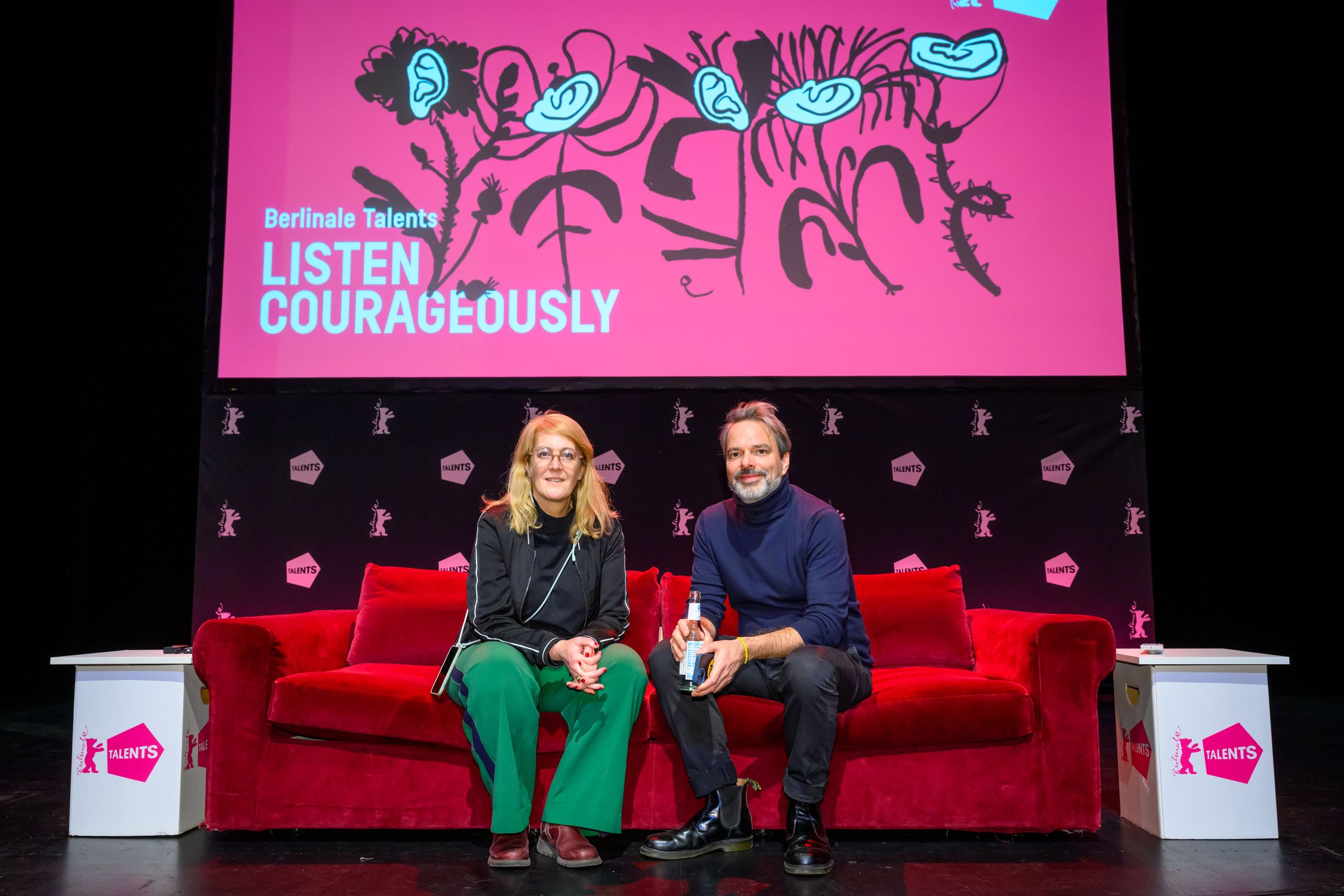
Berlinale Talents will take place for the 24th time this year - what have been the biggest challenges for you since the last edition, and which new partners have you been able to attract?
Financing Berlinale Talents is a challenging but incredibly rewarding task every year. Many partners are now more conscious of their spending, which presents us with a challenge but also opens up new creative avenues. We have one which is not yet publicly announced but can't wait to share as it's an incredibly exciting new opportunity for the Berlinale Talents community, stay tuned! Our continuously growing collaboration with Mastercard also demonstrates how partnerships can evolve. Together we support social initiatives by filmmakers worldwide, and thanks to a donation, we were also able to support the Durban FilmMart's Future Mentors Programme for the first time. We will welcome some of these mentors from Africa to Berlin and involve them in Berlinale Talents. This is a very special moment for us.
However, the reliable support of our public sponsors is just as important. Without them, a project like Berlinale Talents, which brings together around 200 creative professionals from all over the world every year for an intensive training and networking program, would be impossible.
This is our second year working together as a leadership duo, and we feel very fortunate to be able to continue developing this project with such a great team. This year's theme deliberately allows for moments of confusion. This can be unsettling, but it is precisely this irritation that often gives rise to new ideas, unfamiliar perspectives, and bold approaches. This openness has a major influence on our preparations.
We have a number of innovations in store for 2026. Firstly, Berlinale Talents will start on February 13 to make our public talk programme with the Berlinale's guests of honour even more accessible. Secondly, we are also moving to a new location: Radialsystem will become our House of Talents. Lastly, we will involve our now approximately 10.000 alumni even more intensively. It is a vast network that is active worldwide and constantly generates creative and collaborative momentum.
This year, Berlinale Talents will take place at the Radialsystem cultural center for the first time. How did this collaboration come about? To what extent will this new venue influence the design of the Talents programme?
After every successful Berlinale Talents edition, we ask our participants what was important to them? Where can we improve? One wish came up again and again—a central location where everyone could really meet.
For many years, we had a great partner in HAU, for which we are very grateful. With Radialsystem, we now finally have one central venue instead of three. This is a challenge in terms of space, but it creates a real House of Talents. At every corner, at every moment, our 200 talents from 15 disciplines will be able to meet and exchange.
In addition, a programmatic exchange between Berlinale Talents and Radialsystem has begun, which is enriching for both sides and will certainly lead to wonderful shared moments. We can’t reveal any more at this point, but be sure to check out our programme on February 3, 2026, as we have a few surprises in store for you. You can find all the information at berlinale-talents.de.
This year's overarching theme is “Creating (and) Confusion – Cinema, Chaos and the Power of Discomfort.” Art, and cinematic art in particular, continues to be overburdened with political issues. Is this year's theme also a response to this trend?
As in previous years, we wanted to choose a theme that would give space to both the personal circumstances that are essential for creative work and filmmaking itself. After all, a film can never be entirely apolitical, but we wouldn't call it a new trend.
Of course, we respond to the world around us when choosing themes. This keeps our programme alive and relevant. This year, the theme actually arose in the middle of a conversation with talents during the 2025 edition. Someone mentioned the state of confusion—and we both immediately felt a flash of inspiration. This led to a spontaneous, very intense discussion.
That edition dealt with “courageous listening” and the role of film in “times of dissonance.” It became clear how many contradictory narratives, media, opinions, and expectations affect us every day. The new theme felt like a natural continuation of this discussion. So why not consciously dive into this chaos, this state of confusion, and explore what might even be productive or liberating about it?
Is there an inspiration for this year's theme in current cinema? When and where did you last find the power of discomfort in cinema to be productive?
Both of us immediately think of the magnificent and very different films “Sirât” by Oliver Laxe and “Sound of Falling” by Mascha Schilinski.
“Sound of Falling” creates an unease from the dissolution of clear timelines. The kaleidoscopic montage of four women's lives throughout a century forces us to experience familiar narratives of family and history through a new lens. The mixture of sensual closeness and uncanny distance creates a tension that allows the audience to actively interpret the film. Here, discomfort becomes a catalyst for reflection on memory, identity, and the fractures in our own perception.
“Sirât” surprises above all with its consistent dissolution of familiar narrative patterns. The film begins like a road movie, but unexpectedly changes into an existential experience between war, flight, and loss. Sudden plot twists and the disturbingly gradual loss of characters occurs without warning and breaks with all expectations of classical dramaturgy. The film’s sensory design is also unsettling in its alternation between silence and techno, long desert images and abrupt changes of perspective. This combination of formal precision and narrative unpredictability makes the confusion highly palpable and keeps the audience in a state of constant surprise. Both films were made by alumni or with the participation of former Berlinale Talents.
Creating and Confusion: To what extent do you find this premise to be productive for your own work?
Although we are not actively trying to cause confusion, it still sometimes creeps into our daily work anyways. There is something very valuable for us in the idea of Creating Confusion. It is not about creating chaos, but about taking a step back and consciously challenging our own patterns of thinking and acting. This conscious unlearning and relearning is a central part of our work.
We continuously review how we work, how our programme is structured, and what we offer our talents and our audience. We are convinced that it is precisely this constant questioning that enables us to guarantee the quality of our offerings and to explore new and exciting opportunities and topics. The theme also gives our guests and talents the space to confront their uncertainties and thus find surprising food for thought. And that is precisely what we find exciting and creative about Berlinale Talents: there is always room for surprise, development, and new discoveries.
What criteria did you pay particular attention to when selecting this year's Talents, and how are the various trades distributed this year?
To ensure fairness, we as the management team are not directly involved in the selection process. This task is carried out by an independent selection committee consisting of four experts from different parts of the world who bring a variety of professional perspectives to the table.
Apart from the basic admission requirements, there is no rigid checklist. We deliberately assume that Talent is a very broad and individual concept, which is why each application is considered in its entirety. Of course, factors such as professional experience, i.e., education and previous work, are taken into account, as is the technical quality of the film samples submitted. The committee also pays attention to the resonance the work generates, how it relates to communities, audiences, and the industry.
Self-reflection and innovation also play an important role, whether through creative risks, new approaches, or exploring the boundaries of their work. But in the end, it's not about ticking off individual criteria. The overall picture is the most important aspect. Where does the person stand in their career? How much could they benefit from Berlinale Talents? And just as important, what contribution can they make to the group as a whole? It is this holistic picture that ultimately tips the scales.
To what extent is the debate on AI taking up more space in the Berlinale Talents labs and workshops? What new perspectives are being developed?
Artificial intelligence is playing an increasingly important role worldwide. It is now part of every smartphone, supports simple editing programmes and also enables highly complex work processes. At the same time, film remains a medium for us that can merge all these possibilities. It is a space where new tools can be tried out without losing the old ones. It is precisely this simultaneity that fascinates us.
At Berlinale Talents, we ruminates on this spectrum. We are interested in what it feels like to work with film in an analog film lab, a process that requires a completely different kind of discipline and attention. We also ask ourselves what concrete advantages AI offers in today's production processes and how Talents can use it to create, experiment, or push boundaries.
This spectrum is very important to us, and we also see it in the work of our Talents. Some naturally move in digital innovation spaces, others consciously seek analog resistance, and many combine the two. We reflect this diversity in the programme because it realistically depicts contemporary filmmaking and at the same time provides new food for thought.
This year's theme is dedicated to the emergence of new perspectives and the productivity that lies in confusion. In contrast to this, the final act of distributing films primarily focuses on definition, brand and label building, and unambiguous communication. How do you intend to bridge this gap?
For us, confusion is not a contradiction to subsequent clear branding and communication work, but rather the starting point. Confusion opens up a space in which old certainties are briefly suspended. It is precisely at this moment that new perspectives can become visible that would otherwise remain hidden by routines or industry logic.
When we talk about brand or label building, it's not about avoiding ambiguity, but about translating it productively. A strong brand does not arise from smooth unambiguity, but from a clear stance. And this stance often only emerges once friction, doubt, or surprising changes of perspective have been allowed to occur.
Our bridge, then, is to view confusion not as chaos, but as a creative resource, as a process that forces us to decide more consciously what we really want to communicate. It expands the space of possibilities, and subsequent definition focuses it. Both phases belong together.
We therefore understand this year's theme as an invitation to first open up our own perspectives before narrowing it.
The “Dine & Shine Dinner” is a highlight among the Talents programme items. What can we expect from the event this year?
Dine & Shine is indeed a very special moment in the Talents programme every year. This time, too, everyone can look forward to a very lively evening. More than 400 guests will come together - our 200 talents, plus just as many industry experts and filmmakers from across the festival.
Regular table changes automatically lead to new encounters and conversations – that's what makes the evening so dynamic. That's how many discover people, ideas, or potential collaborations that they hadn't previously had on their radar.
Another highlight is the announcement of the new scholarship recipients of the Berlinale Talents Mastercard Enablement Programme, which every year demonstrates how much commitment and potential for the future exists within our community.
In short, you can look forward to an open, inspiring atmosphere and many opportunities for genuine exchange. This is where the best connections for film and life are made.
Berlinale Talents poses a budgetary challenge each year – how do you tackle that?
Every year, we secure the funding for Berlinale Talents again, and although it is a big challenge, we greatly value it. It gives us the opportunity to develop new formats together with our partners, forge fresh ideas and open doors for our Talents and alumni.
This year, for example, we are creating a brand new workshop with Warner Bros. Discovery. With ARTE, we are inviting filmmakers who have made their festival films in collaboration with ARTE. TikTok is bringing its creators to Berlin for a direct peer-to-peer exchange, and we are looking forward to getting to know six projects from Mongolia. The VFF will honour producers from the Talent Project Market, while other partners are hosting brunches and happy hours – all of which contributes to the special atmosphere.
Our sponsors – the BKM, the Medienboard Berlin-Brandenburg, the FFA and Creative Europe MEDIA – make Berlinale Talents possible in the first place. And of course, we mustn't forget Mastercard - our long and wonderful partnership as part of the Berlinale Talents Mastercard Enablement Programme is a central pillar of what we offer. As we already mentioned, we also have an extremely exciting new partner collaboration to announce in the near future, which provides a really unique and incredibly generous opportunity for our alumni community. As you can see, it really never gets boring.
And yes, it takes a lot of energy. But when we welcome the 200 talents in February and see what we create together, we know every time that every effort has been worth it.